Where does the unit wait?
A closet at 0 to 40 °C is a different environmental ask from an unconditioned enclosure. Copy the range from the datasheet of the named model. Do not take it from the paint color in the image.
ROUTE PHOTOS ARE CLUES, NOT SPECIFICATIONS
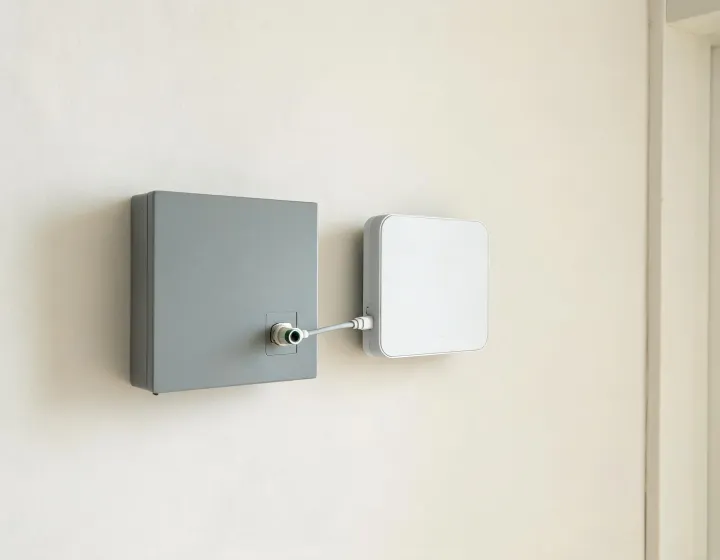
An onu optical network unit image shows a shape, a port count you can try to count, and sometimes a connector color. It does not show wavelength, optical budget, firmware, or the OLT profile. Use the picture to write a purchase line, then ask the supplier to confirm every cell the picture cannot prove.
LinkScope Sourcing 09 is an independent sourcing partner for that translation. The photograph stays in your project file. The quotation has to name a model.
From the image, count holes and connector colors, then stop. Add data rate, fiber mode, reach, and the voice or RF need in words. Single-mode is the usual access assumption; say so explicitly if the plant is single-mode, and do not borrow a multimode rule from a data hall.
Ask for the model that matches the counted faceplate. Split the unit price from the pigtail, the adapter, freight, and any commissioning visit. A buyer preference for high-end, mid-range, or budget hardware is a filter, not a test result.
Record who approves the connector polish and the optical power measured at the drop. Ingress protection matters if the image shows an outdoor box. A mating-cycle note matters if technicians will reseat the connector during turn-up.
Decide whether diagnostics must remain visible after installation, and who stores the datasheet. A managed profile can help operations and can also add configuration to maintain. A simpler bridge can be enough when the route never needed that visibility. Write the choice down so a later spare matches it.
Project constraints to confirm with the supplier, not with the photo: operating temperature, power-input voltage, tray depth, and whether the drop loss still fits the optical class after the splitter. An IEEE Ethernet overview checked on 2026-10-27 can frame UNI questions. It does not prove a PON link.
Read one route photo as a worked check, not as a finished order. Background: the image shows a wall box and a faceplate, and nothing about the OLT. Process: count the holes, write single-mode or flag a multimode mismatch, then ask the supplier for wavelength, transmit power, receiver sensitivity, optical budget, return loss, insertion loss, connector mating-cycle guidance, and the data rate of both the PON port and the Ethernet ports. Result you can file: a line that either matches the counted ports and the stated loss budget, or comes back as a deviation. Indoor closets are often discussed around 0 °C to 40 °C; an outdoor box needs the ingress protection code from the sheet. Keep GPON and EPON on separate lines. Treat 1310 nm, 1490 nm, any 1550 nm overlay, 2.488 Gbit/s downstream, 1.244 Gbit/s upstream, and a Class B+ 28 dB figure as questions for that model. A managed profile and a plain bridge are both legitimate when the route’s need for diagnostics is written down. This desk does not measure the drop and does not certify the host pair.
A closet at 0 to 40 °C is a different environmental ask from an unconditioned enclosure. Copy the range from the datasheet of the named model. Do not take it from the paint color in the image.
Ask for the datasheet, a port drawing, and any authorization file the destination requires, each tied to the model. Packing photos can support a receiving check. They do not replace the sheet.
State whether your team powers the ONU, whether a supplier technician configures it, and whether that labor is inside the quotation. Commissioning left out of the price will reappear as a separate cost.
A spare row should repeat the same model and revision. Mixing a later faceplate because the image looked similar breaks the optical and management assumptions of the live route.
Related reading: GPON and EPON lines on one BOM and the brief form.
Describe what the image shows, then list the cells it cannot show. Add quantity, destination, and timing. Factories should answer the cells, not the picture.
QUALIFIED BUSINESS BUYERS
Compare quotations from up to 3 factories after the ONU requirement is written down.
Eligibility applies to qualified business buyers and is confirmed after we review your product, quantity, destination, and sourcing requirements.