SUBMIT THE BRIEF
LinkScope Sourcing 09
This page is the working desk. The inquiry dialog elsewhere is a narrow form. Here the communication path sits beside the form so you can see which fields the comparison actually uses.
How a packet moves
- You submit the specification, the quantity, the destination, and the timing.
- The desk checks whether the port map, PON family, connector, and optical questions are complete enough to send.
- Factories that receive the packet answer on that basis. A different optical class comes back as a deviation.
- You compare the replies. Selection stays with your team.
Channels that exist
- Written brief: the form on this page.
- Reply path: the work email you type. No second mailbox is published.
- Phone: not published. A voice call drops the wavelength and budget cells.
- Hours: US business days for reading. The form time is not a delivery commitment.
- Social accounts: none are used for quotations.
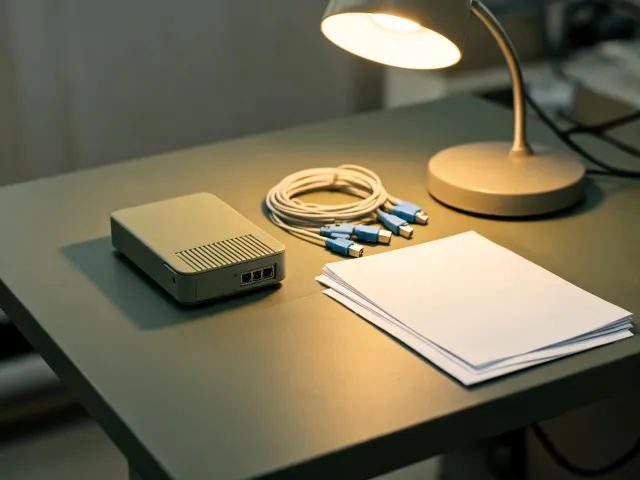
The illustration is a review bench. It is not a map pin and not a street address. Do not ship hardware to a picture.
Cells to fill before you ask for a number
Interface type, data rate, wavelength, fiber mode, reach, connector polish, optical budget, diagnostics, temperature range, and the OLT you need the device to answer. Quantity in pieces. US destination. Expected timing for incoming inspection.
Say whether voice ports are required and whether any UNI must supply Power over Ethernet. A four-port faceplate does not answer either point. Transmit power and receiver sensitivity should be requested from the datasheet, with units, rather than copied from a neighboring model.
An optional target budget needs a currency and a basis: per unit or the whole order. High-end, mid-range, budget, or undecided describes the replies you want to see. It is not a score this desk has verified, and you can send the brief before a factory has priced anything.
If a drawing will not fit, say that in the requirement field. There is no upload control. Reference questions gathered on 2026-10-27 from public optical-fibre and equipment-authorization pages do not replace the supplier’s current sheet.
Useful prompts to type when you know them: 1310 nm and 1490 nm as the wavelengths to confirm, a loss budget in dB, SC/APC or SC/UPC, and the line-rate pair you expect the PON port to use. Leave a cell empty instead of guessing.
Split GPON from EPON before you ask for a price. GPON buyers usually point at ITU-T G.984 framing and the often-cited 2.488 Gbit/s downstream and 1.244 Gbit/s upstream pair. EPON buyers point at IEEE 802.3 point-to-multipoint and must state their own line rate in the same units. Similar wavelengths do not make the families interchangeable. State single-mode when that is the plant; a multimode jumper is a different bid. If the UNI must deliver Power over Ethernet, name the watt budget instead of assuming a voice port can do it. Ask the sheet for transmit power, receiver sensitivity, optical budget, return loss, and insertion loss, each with units, plus ingress protection and a connector mating-cycle note when technicians will reseat the plug. A 28 dB Class B+ figure and a 1550 nm overlay are confirmations, not values this desk has measured. This page does not publish a street address, a phone number, or a saving percentage.